Balance Training
Balance Training
Most of us rarely think about our balance until we lose it. Standing up from a chair, turning around to answer someone, walking through a crowded market, climbing stairs, or simply reaching for something on a shelf all require good balance. After a neurological condition, these everyday activities can suddenly become difficult and even frightening. Many people begin to fear falling, and this fear often makes them move less, which can further reduce strength, confidence, and independence. At Neurowalk, we help patients break this cycle through personalized Balance Training, allowing them to move more safely and confidently in their daily lives.
Balance is much more than standing without falling. It is the body’s ability to keep itself stable while remaining flexible enough to respond to movement. Every time we walk, change direction, step over an obstacle, or reach for an object, our brain is processing information from our eyes, inner ears, muscles, joints, and skin. All of these systems work together within milliseconds to help us stay upright. When the brain or nervous system is affected by conditions such as stroke, Parkinson’s disease, multiple sclerosis, traumatic brain injury, cerebellar disorders, vestibular disorders, spinal cord injury, or peripheral neuropathy, this coordination may no longer work efficiently. As a result, patients may experience unsteadiness, frequent falls, dizziness, difficulty walking, or hesitation during movement.
At Neurowalk, we believe that improving balance begins with understanding why it has been affected. Every rehabilitation journey starts with a comprehensive assessment carried out by our neurorehabilitation team. We don’t simply observe whether a patient can stand or walk. We look at posture, weight distribution, muscle strength, trunk control, coordination, gait pattern, reaction time, sensory function, and confidence while moving.
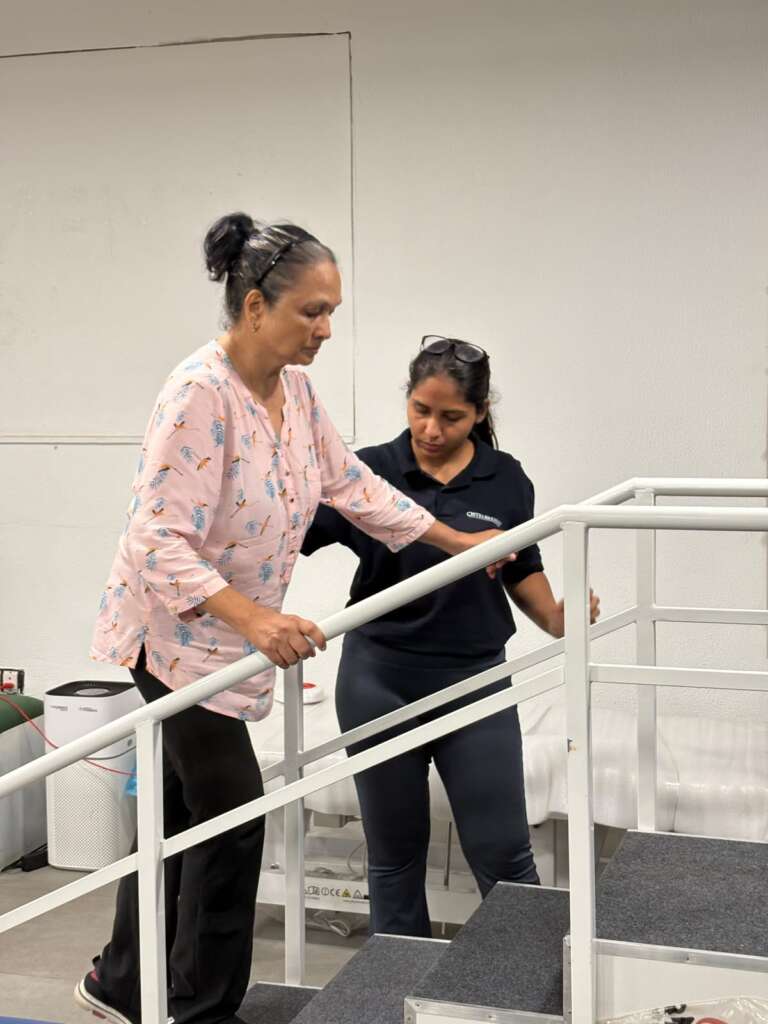
Balance Training is never limited to standing on one leg or using balance equipment. Our therapists focus on helping patients develop the skills they need for everyday life. Depending on the patient’s condition, therapy may begin with simple activities such as maintaining sitting balance, shifting weight from one side to the other, or standing with proper posture. As confidence improves, the exercises gradually become more functional. Patients may practise turning while walking, stepping over obstacles, changing directions, climbing stairs, reaching beyond their base of support, or walking on different surfaces. Every activity is chosen with a clear purpose and is progressed according to the patient’s abilities.
One of the most important goals of Balance Training is to reduce the fear of falling. Many patients become overly cautious after experiencing a fall or feeling unstable. Although this response is understandable, it often limits movement and reduces participation in daily life. Our therapists create a safe and supportive environment where patients can practise challenging activities under close supervision. As they experience success during therapy, confidence gradually replaces fear, making movement feel more natural and secure.
Good balance also depends on strong core muscles and effective trunk control. At Neurowalk, our rehabilitation sessions often include exercises that improve stability around the pelvis, abdomen, and spine. A stable trunk provides a solid foundation for controlled arm and leg movements, making everyday activities such as walking, reaching, and transferring much easier.
Another important aspect of Balance Training is preparing patients for situations they encounter outside the clinic. Real life is unpredictable. People need to stop suddenly, avoid obstacles, turn quickly, carry shopping bags, or walk while talking to someone. Our therapists gradually introduce these real-world challenges into rehabilitation so that patients are better prepared to move confidently in their homes and communities.
Technology and specialized equipment may also be used when appropriate to make rehabilitation more effective. However, equipment alone is never the treatment. It is the clinical expertise of our therapists that determines how each activity is selected, progressed, and integrated into the patient’s rehabilitation journey. Throughout every session, our team continuously monitors safety, fatigue, posture, and movement quality, ensuring that each exercise remains both effective and achievable.
Balance Training is often combined with other evidence-based rehabilitation approaches such as PNF, Motor Relearning Program, gait training, Dual Task Training, robotic-assisted rehabilitation, sensory re-education, and strengthening exercises. By addressing multiple aspects of movement together, we help patients achieve improvements that carry over into everyday activities rather than remaining limited to the therapy room
Recovery looks different for every individual. For one person, success may mean standing independently after several weeks of rehabilitation. For another, it may mean walking outdoors without fear, climbing stairs confidently, or returning to work. No matter how large or small the goal, every milestone represents meaningful progress. Our team believes that these achievements deserve to be celebrated because they reflect not only physical improvement but also renewed confidence and independence.
At Neurowalk, Balance Training is designed to help people move with greater stability, confidence, and freedom. Through detailed assessment, individualized rehabilitation, and evidence-based care, our neurorehabilitation team supports every patient in building the balance they need to participate safely and confidently in everyday life.