Cognitive Motor Training ( CMT )
Cognitive Motor Training ( CMT )
Walking through a busy market, remembering a shopping list, answering a phone call while climbing stairs, or reaching for an object while having a conversation are activities most of us perform without much thought. These everyday tasks require the brain and body to work together continuously. Following a neurological condition, however, this connection may not function as efficiently. A person may walk well but struggle when asked a question at the same time, or they may remember instructions but find it difficult to coordinate their movements. At Neurowalk, Cognitive Motor Training is used to strengthen this connection between thinking and movement, helping patients become more confident and independent in their daily lives.
Cognitive Motor Training is an evidence-based rehabilitation approach that combines physical movement with cognitive activities. Instead of treating the brain and the body separately, this therapy recognizes that both systems constantly work together during everyday life. By training them simultaneously, patients learn to process information, make decisions, maintain attention, and move safely even when faced with real-world challenges
Neurological conditions such as stroke, traumatic brain injury, Parkinson’s disease, multiple sclerosis, dementia, and other disorders can affect both physical abilities and cognitive functions. Patients may experience reduced attention, slower thinking, memory difficulties, poor problem-solving skills, or delayed reaction times. These changes often interfere with mobility, increase the risk of falls, and make routine activities more challenging. Cognitive Motor Training is designed to address these difficulties in a structured and meaningful way.
Every rehabilitation journey at Neurowalk begins with understanding the individual rather than simply focusing on the diagnosis. Our neurorehabilitation team performs a detailed assessment of movement, balance, coordination, memory, attention, executive function, processing speed, and functional abilities. We also spend time understanding the patient’s lifestyle, daily responsibilities, and personal goals. This allows us to design therapy sessions that are practical, engaging, and directly relevant to the person’s everyday life.
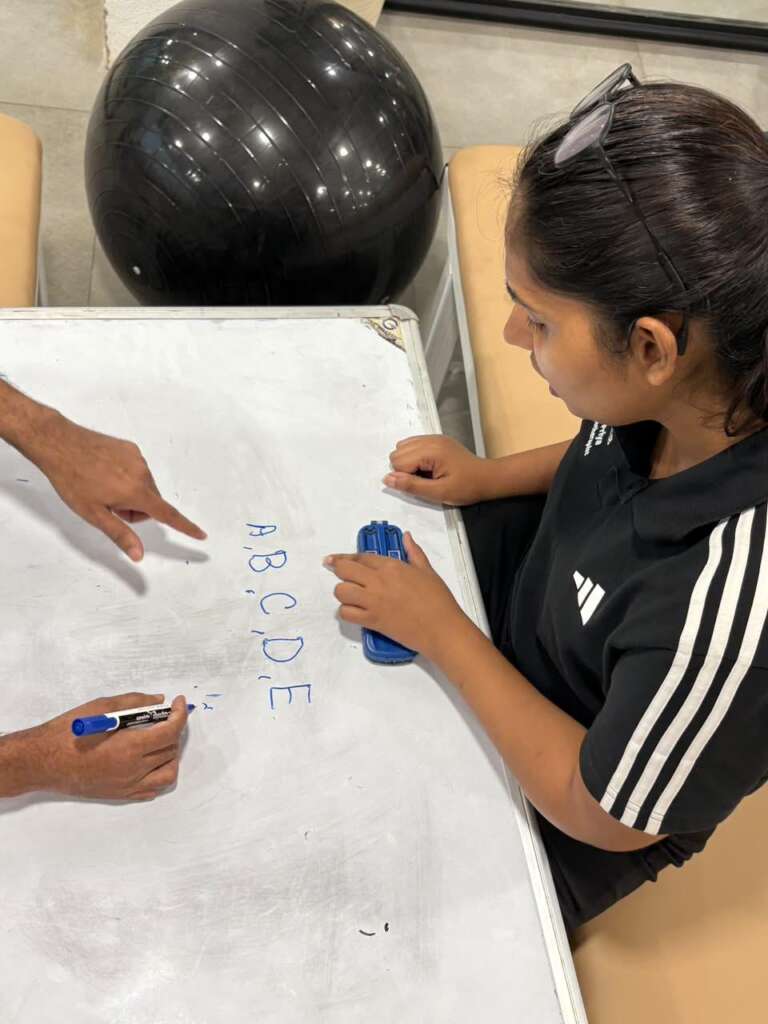
During a Cognitive Motor Training session, patients perform physical activities while simultaneously completing thinking tasks. For example, they may walk while identifying pictures, remember a sequence of numbers while reaching for different objects, perform stepping exercises while responding to questions, or practise balance activities while solving simple problems. These exercises are not meant to test intelligence. Instead, they challenge the brain’s ability to organize movement and thinking together, just as it does during normal daily activities.
One of the greatest advantages of this approach is that it closely reflects real-life situations. Outside the clinic, people rarely perform only one activity at a time. They carry groceries while planning dinner, talk to family members while walking, or make decisions while moving through busy environments. By practising similar situations during rehabilitation, patients become better prepared for the demands of everyday life.
Our therapists carefully adjust the level of difficulty according to each patient’s abilities. If a task is too easy, it may not stimulate meaningful improvement. If it is too difficult, it can become frustrating and reduce confidence. Finding the right balance is an important part of successful rehabilitation. As patients improve, the activities are gradually progressed by increasing movement complexity, introducing new cognitive challenges, or creating situations that require faster decision-making.
An important principle behind Cognitive Motor Training is neuroplasticity. The brain has the remarkable ability to reorganize itself by forming new neural connections after injury. Every successful attempt to think, respond, and move at the same time strengthens these pathways. With repeated practice, patients often become more efficient at processing information while maintaining safe and coordinated movement.
At Neurowalk, we believe rehabilitation should always have a purpose. Rather than asking patients to complete repetitive exercises without context, we encourage them to practise meaningful activities that support their personal goals. Someone returning to work may need better concentration while moving around an office. An older adult may wish to walk safely while talking with family members. Another patient may simply want to feel more confident when managing daily household activities. By understanding these goals, our team ensures that every rehabilitation session has a clear direction.
Cognitive Motor Training is frequently combined with other evidence-based approaches such as Balance Training, Dual Task Training, PNF, Motor Relearning Program, gait training, sensory re-education, and functional task practice. Combining these therapies allows us to address movement quality, cognitive function, endurance, coordination, and confidence within a single rehabilitation program. This integrated approach often produces more meaningful improvements than focusing on only one aspect of recovery.
Recovery is not measured only by stronger muscles or faster walking. It is also reflected in the ability to make decisions confidently, respond to changing environments, remember instructions, and participate in family, work, and social life. These are the abilities that allow people to regain independence and reconnect with the activities that matter most to them.
At Neurowalk, Cognitive Motor Training is designed to help patients strengthen both the mind and the body together. Through individualized assessment, evidence-based rehabilitation, and close guidance from our experienced neurorehabilitation team, we help people improve their movement, sharpen their thinking, and confidently return to the demands of everyday life.